
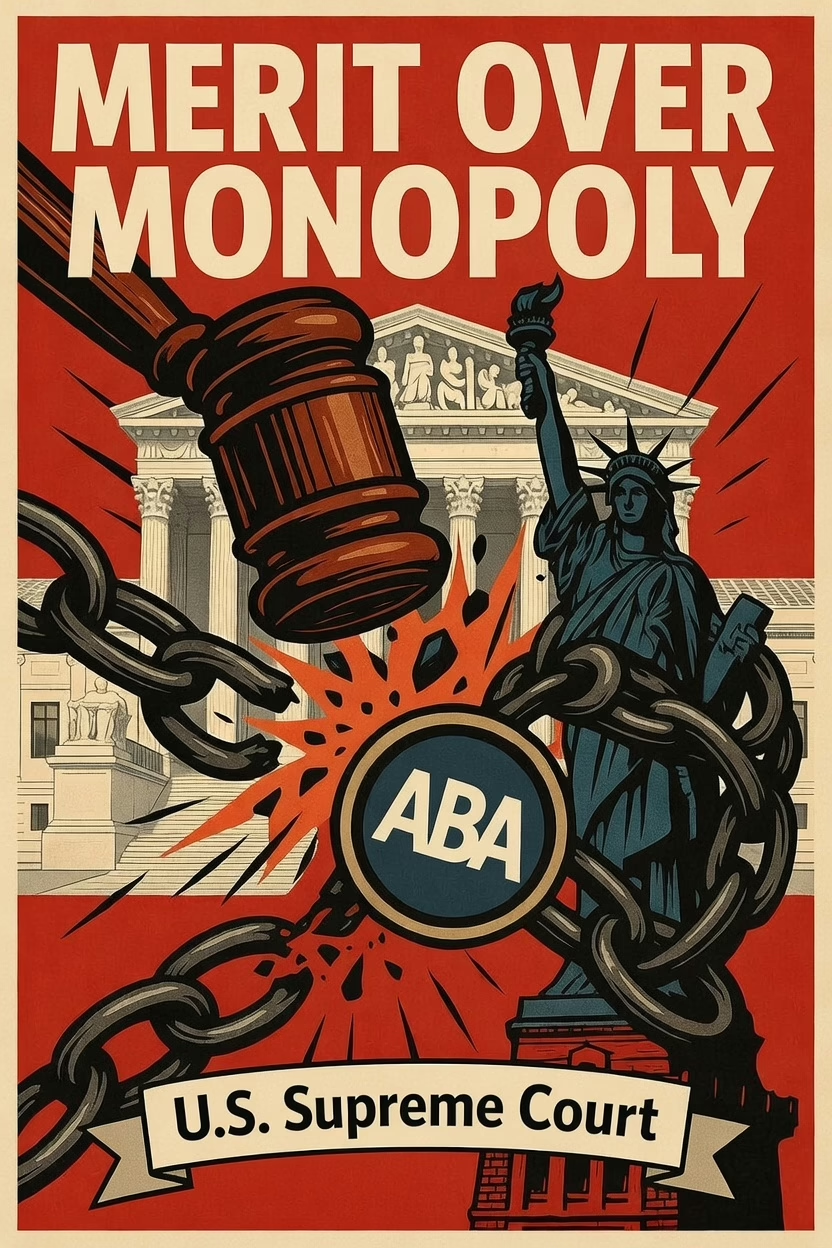
Case Updates
***Thank you to those who share and support this effort to restore our God-given right to earn a living and end discriminatory practices to restore merit-based opportunities to all Americans.***
Case Summary:
This case argues that Pennsylvania’s requirement that bar applicants must have graduated from an ABA law school is purposefully discriminatory and unconstitutional. Alex petitioned the U.S. Supreme Court, arguing that the rule violates the God-given fundamental right to earn a living (to work in one’s chosen occupation) and the Due Process and Equal Protection Clauses of the Fourteenth Amendment. The case shows the history of Pennsylvania and the ABA’s racial discrimination against Blacks, women, Jews, other minorities, and now Whites, which is unacceptable, as the ability to earn a living should be merit-based.
This matter is significant because of individual rights, access-to-justice issues, and the fact that states impose licensing requirements on Americans’ ability to work in over 35% of all occupations. Although the case started in Pennsylvania, the matter concerns all Americans’ rights because of the constitutional issues raised, as the individual right to earn a living and the type of limitations states can impose cannot vary by state.
Last Update: 2/10/2026 Past Case: In re: Alexander Keely.
Current case caption (as by the Supreme Court Clerk):
Alexander David Keely v. Pennsylvania Board of Law Examiners
Case Status – No. 25-926
- Original Petition to the Pennsylvania Supreme Court – June ’25
- Answer by Pennsylvania Board of Law Examiners – July ’25
- Denial of Petition, Pennsylvania Supreme Court 10/27/25
- Keely’s Petition for Writ of Certiorari, U.S. Supreme Court Filed and accepted by the Clerk – 01/20/26
- PBLE Waiver of a Response – 2/11/2026 (awaiting filing from the clerk).
- Awaiting amicus briefs or Justice(s) forcing a response.
U.S. Supreme Court Petition – Keely
In Re: Alexander Keely, filed and docketed with the Supreme Court Clerk:
Case No. 25-926.
QUESTIONS PRESENTED
Shortly after the Civil Rights Act of 1964, when most American Bar Association (ABA) law schools had not yet admitted Black students or minorities, Pennsylvania created rules that prohibited all historically qualified applicants from obtaining standard admission to the bar unless they had graduated from an ABA-accredited law school. As in Dent and Douglas, professional licensing limitations throughout relevant ratification periods were always specific to an individual’s “knowledge and skill” and did not ever authorize bare rational basis deference.
In Heller, McDonald, and Bruen, this Court restored fundamental core protections of Second Amendment rights by holding that restrictions
inconsistent with America’s historical tradition of regulation are unconstitutional. Since ABA’s inception and persistent racial discrimination began in 1878, states have been divided on whether the fundamental right to earn a living could be legitimately restricted by an accreditation monopoly.
The questions presented are:
- Whether Pennsylvania’s ABA monopoly within professional licensing qualifications exceeds the limits of Bruen’s text, history, and traditions test in violation of the Fourteenth Amendment.
- Whether Pennsylvania’s ABA monopoly survives strict scrutiny or invidiously discriminates against Blacks in violation of the Equal Protection Clause of the Fourteenth Amendment.
- Whether procedural due process rights of the Fourteenth Amendment are violated by Pennsylvania’s failure to assess an individual’s similar educational qualifications for licensing.
Introduction – Initial Filing – Keely
This Court’s general authority and King’s Bench jurisdiction empower it to address the constitutionality of issues threatening the integrity of the Commonwealth’s judicial system and matters of immediate public importance.[1] For over a century, Pennsylvania’s bar admissions rules have unjustly perpetuated discriminatory barriers, denied qualified individuals access to the legal profession, and undermined public confidence in a fair and equitable judiciary. These activities occurred while every branch of the Pennsylvania government recognized that racial minorities and lower and middle-income residents have struggled to achieve the American dream without the necessary access to justice support needed to solve their most pressing and life-altering legal challenges.
This petition references this Court’s exclusive jurisdiction over bar admissions rules and argues for removing the unwarranted and discriminatory impediments to the bar by describing how the past adoption of the American Bar Association (“ABA”)-accreditation monopoly in legal education qualifications violates the fundamental rights of Petitioner. Constitutional protections apply to the fundamental right to work, which is incorporated in the liberty and property interests codified by the people in the Fifth and Fourteenth Amendments.[2] Historically legitimate professional licensing restrictions on the fundamental right to work are often and appropriately given only rational basis scrutiny, with much deference given to the states. However, this petition will demonstrate that U.S. Supreme Court precedents in similar constitutional rights cases require this Court to hold that restrictions created outside of historically acceptable limitations on fundamental rights are unconstitutional. This petition proves that the current ABA-accreditation requirement falls entirely outside the bounds of historical and Supreme Court-defined professional licensing limitations on individual qualifications, forcing a monopoly in legal education providers that must not be used to prevent or substantially delay well-qualified applicants’ access to the bar.
In addition to violations of historical professional licensing limitations, this petition demonstrates how Pennsylvania’s adoption of ABA’s racially discriminatory practices has invidiously discriminated against Petitioner and other Blacks and minorities. These actions violate the Equal Protection and Due Process Clauses of the Constitution, the Civil Rights Act of 1964, and Pennsylvania’s Human Relations Act (“PHRA”) through a combination of discriminatory impact and purpose behind this monopoly in legal education.
Finally, this petition argues that, aside from all other arguments, procedural due process rights require Pennsylvania to conduct individual assessments of educational qualifications before preventing Petitioner’s ability to practice law in the state. Alternatively, Petitioner argues that this Court has already implemented rules that satisfy traditional goals of preventing fraud and harm to the public through existing professional licensing requirements, including the bar examination, professional responsibility tests, and background investigations, which appropriately safeguard competency to practice law and justify removing the education requirement altogether.
Petitioner is compelled to seek extraordinary relief because this Court’s past creation of the ABA-monopoly is an entrenched violation of individual constitutional rights and the public’s right to a fair and accessible bar. While the Court may be hesitant to overhaul these rules, reforming the bar is essential to align with the historical and non-discriminatory professional licensing standards that Petitioner’s and other Pennsylvanians’ constitutional rights demand. By utilizing plenary authority to review and revise these harmful rules, the current Court can remove long-standing discrimination, uphold its constitutional mandate to regulate the bar, restore trust in the judiciary, and provide Pennsylvanians greater access to justice by opening the bar to all qualified applicants.
[1] In re Bruno, 627 Pa. 505, 565, 101 A.3d 635, 671 (2014).
[2] U.S. Const. amends. V, XIV.
See below for the entire petition to the Pennsylvania Supreme Court:
Response – Pennsylvania Board of Law Examiners
**PA Supreme Court Case Update** The Pennsylvania Board of Law Examiners (PBLE) filed its response this week in my case, which seeks to eliminate the ABA monopoly in legal education qualifications and allow all qualified applicants access to the bar to practice law. As the matter is now before the justices, please repost, share, like, and comment to spread the word! #MeritOverMonopoly #AccessToJustice
See the full response below: